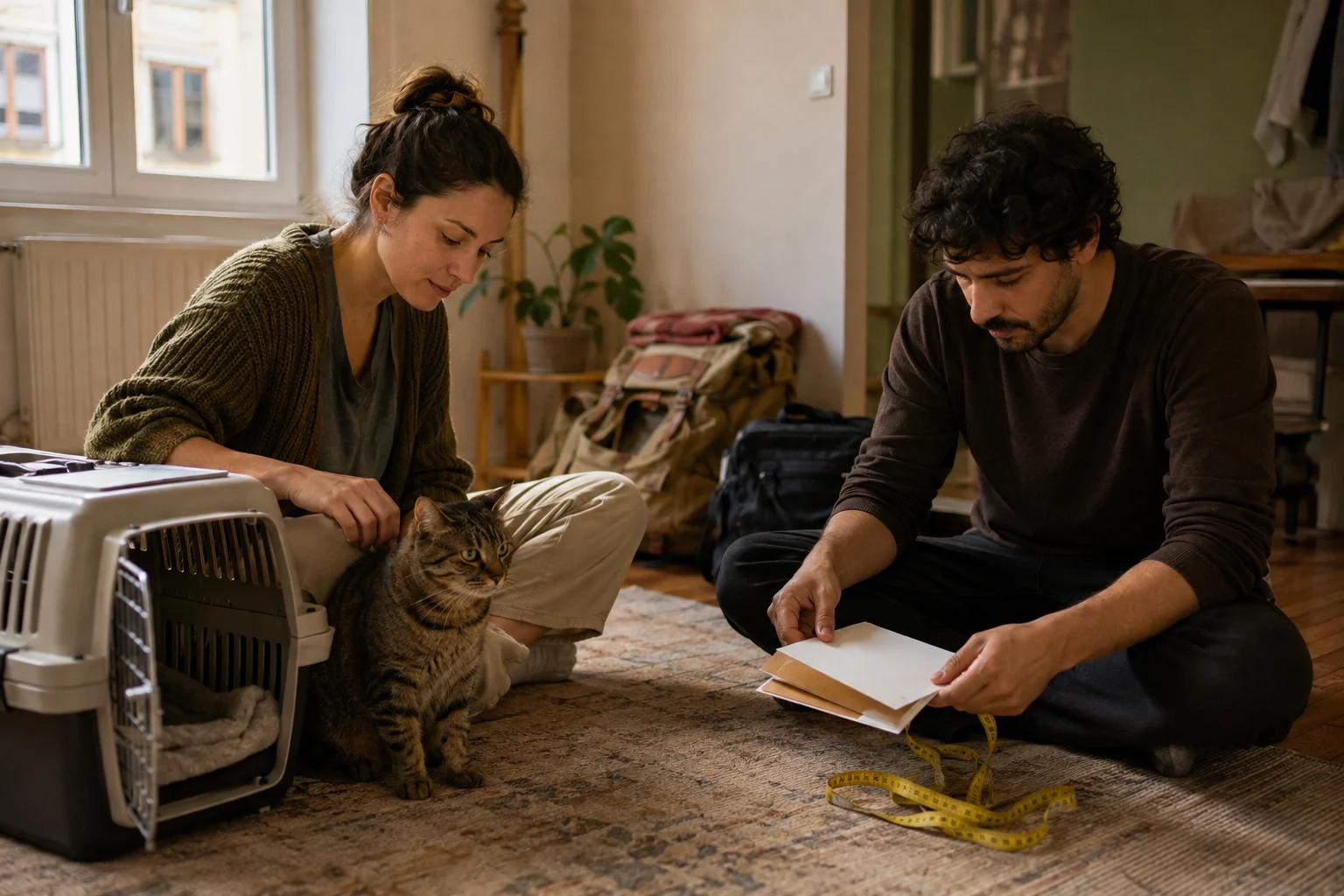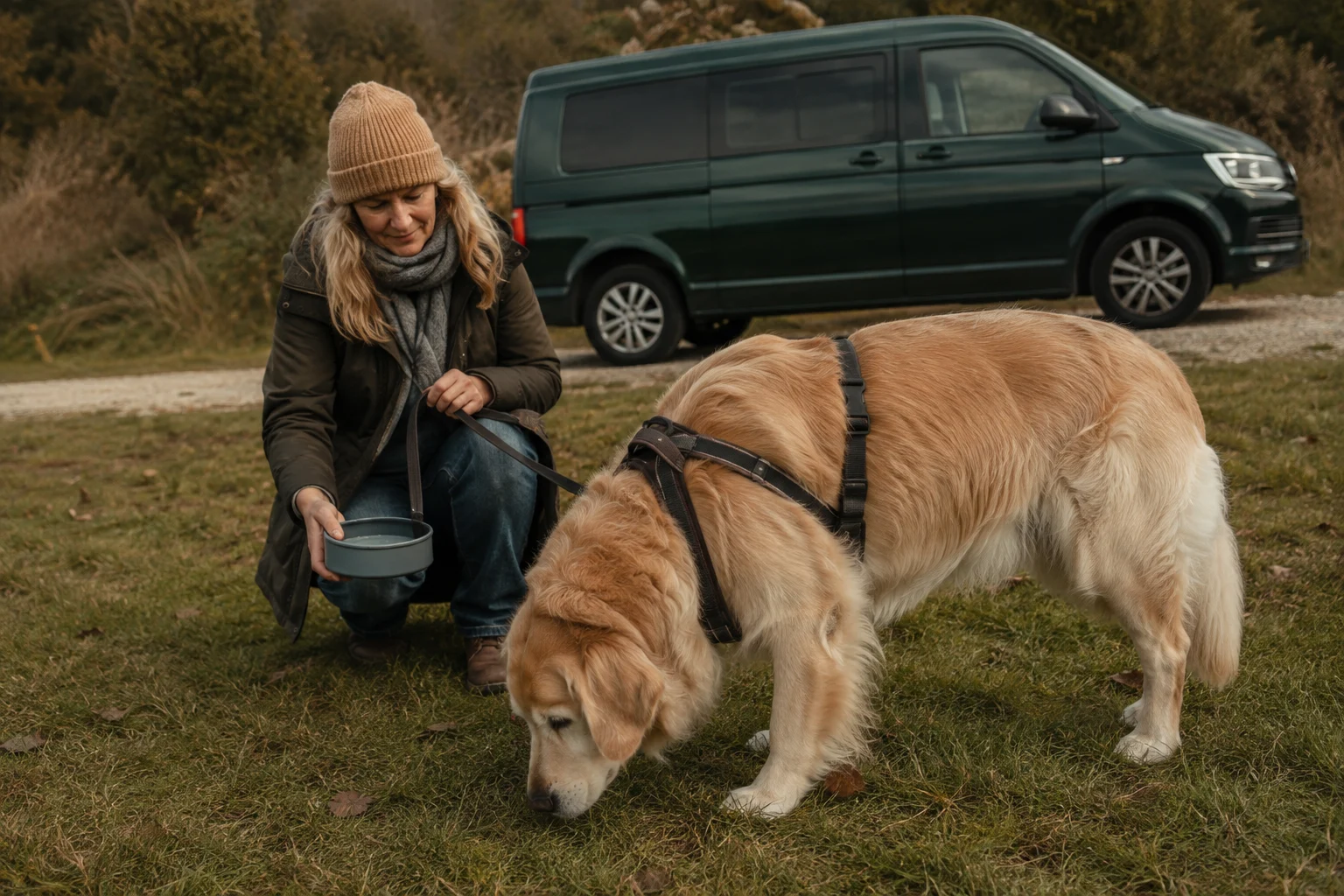
For households planning travel with pets and personal belongings. This guide covers the move itself; plan housing, immigration procedures and living costs separately. All figures in the worked examples are hypothetical.
Decide where the move ends
“Delivery to Belgrade” could mean arrival at the airport, unloading outside a building or carrying boxes into an apartment. These are different jobs with different costs. Record the starting and finishing points, passengers, pets, belongings, acceptable dates, overnight stops and help required on each leg. If you do not yet have an address, give the neighbourhood and mark the final transfer as provisional.
Keep travel and settling-in costs in separate groups. A housing deposit, furniture and money for your first months may all be needed around the same time as transport payments. Seeing them together helps you plan available cash, but a combined total makes routes harder to compare. Keep one total for the move and another for the money you need available before departure. A refundable deposit still needs funding today, even if you expect to get it back later.
Count passengers, pets and belongings separately
Start with three lists, then connect them into an itinerary. Your household might fly with suitcases while boxes travel by road. That creates two arrival dates, a collection arrangement and a need to pack for the first few days. Decide what must arrive with you: pet food, familiar bedding, clothes and work equipment.
Air Serbia charges for pet transport per flight and requires confirmation of a pet’s place. Your baggage allowance depends on your ticket; another airline’s rules may apply when it operates part of the journey. Match each charge to the relevant leg.
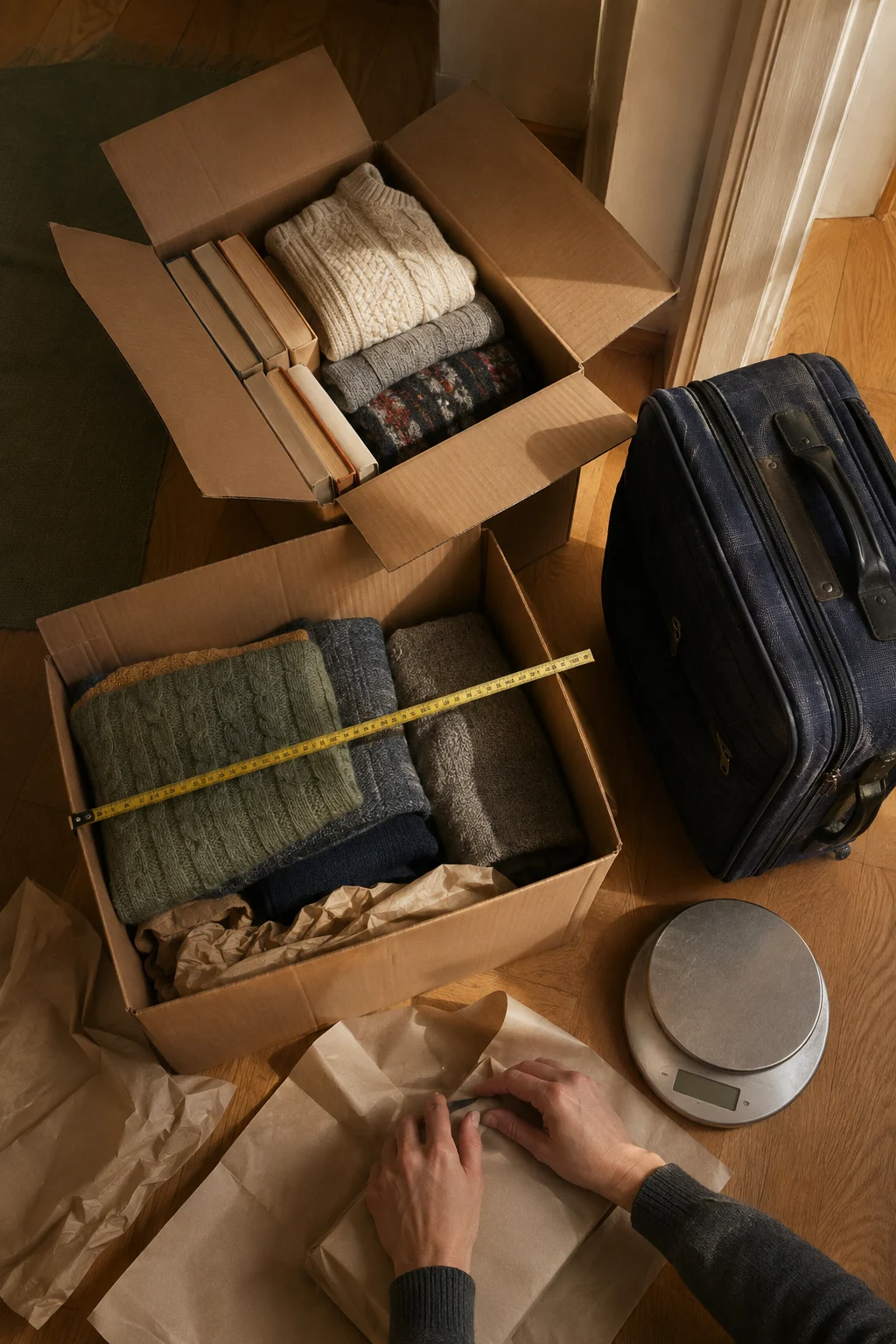
For boxes, prepare an inventory with outside dimensions after packing and estimated weights. Ask whether the price is based on items, kilograms, volume or the whole vehicle. A photograph helps explain the load, but measurements give the provider something to calculate.
Check the rule: Air Serbia: travelling with your pets · Air Serbia: baggage
Separate confirmed prices from estimates
Give every line an amount, currency, service description, price expiry date and status. Four useful statuses are confirmed in writing, provisional estimate, awaiting reply and paid. A blank amount is an unknown cost. Use zero only when a service is included or unnecessary.
For variable expenses, write down the calculation: nights multiplied by the agreed room price, or waiting hours multiplied by the rate after the free allowance. Ask who records when waiting starts and how partial hours are rounded. Keep the agreed inventory and service list alongside any fixed price.
The US FMCSA explains binding and non-binding estimates and connects the estimate to the goods and services involved. Its rules concern US interstate moves. For your own route, ask the provider to explain in writing when its price becomes final and which changes allow it to recalculate the amount.
Check the rule: FMCSA: how can I avoid unexpected moving costs?
Compare offers against the same brief
This teaching example compares two offers for the same job: two passengers, one pet, four suitcases, travel between agreed addresses and one overnight stay. Every amount is invented to explain the calculation. These are neither MIRNO tariffs nor estimates of market prices.
Offer A initially lists only the main transport. Offer B includes several services in its package. Once both cover the same items, A costs 40 EUR more. This compares cost under the stated assumptions; journey duration, arrangements for the pet and cancellation terms still need a separate comparison. If a service has not been confirmed, the resulting total remains provisional.
| Item | Offer A | Offer B |
|---|---|---|
| Main transport | 900 | 1,150 |
| Pet transport | 100 | Included |
| Four suitcases | 80 | Included |
| Delivery to the final address | 70 | Included |
| One overnight stay | 90 | 90 |
| Hotel pet supplement | 40 | Included |
| Total for the agreed services | 1,280 EUR | 1,240 EUR |
Keep the original payment currency
Retain each amount in its payment currency, even when you convert everything to euros for comparison. Record the exchange rate used, the conversion date and any known payment fee separately. Otherwise an exchange-rate movement can look like a provider’s price increase. Until you pay an outstanding invoice, its converted value is an estimate.
For an exercise only, assume an invoice of 12,000 RSD and a planning rate of 120 RSD to 1 EUR. The comparison table would show 100 EUR: 12,000 divided by 120. This is a hypothetical rate, not a current quotation. If an agreed payment fee adds 2 EUR, the complete line is 102 EUR.
Add the deposit and balance due dates. A deposit already paid forms part of the total price, so subtract it from the amount still due. In offer B, a 300 EUR deposit leaves 940 EUR outstanding if the total remains 1,240 EUR.
Give each contingency a specific purpose
List the events that could require extra money: another night, paid box storage or a changed collection date. Estimate a separate amount for each and check whether the package already includes it. Ask the provider how much free storage or waiting time it allows. This gives you a reserve you can explain and update.
For offer B in our teaching example, allow 90 EUR for an additional night and 60 EUR for a possible extra transfer. The reserve is 150 EUR, bringing the planned funds for this option to 1,390 EUR: 1,240 plus 150. The underlying service price remains 1,240 EUR. You do not need to spend the reserve in advance.
If you also add a general percentage for unknown expenses, explain which risks it covers beyond those already listed. An extra night can easily be counted twice, once as a named expense and again within a percentage allowance.
Agree how price changes work before paying a deposit
Imagine that you add two boxes or move the departure date. Ask what a revised offer would show: the original price, changed scope, increase or reduction, new total and your response deadline. This makes the reason for a changed price easier to check.
Clarify which expenses the provider may incur before you approve, how approval is recorded and what happens if you decline the revised arrangement. Read the cancellation, deposit refund and replacement-provider terms separately. A price described as fixed needs clear conditions attached to it.
Save the latest agreed estimate with your inventory and confirmations. If the route changes, revisit dependent expenses such as a prepaid hotel, transfer and delivery collection. Account for refundable amounts when recalculating, and mark refunds that have not yet arrived. Until the money returns, it is unavailable to fund the new booking.
Send every provider the same request
Copy the outline below and fill in what you know. Mark anything undecided. Trip parameters are enough for an initial calculation; document numbers and scans are unnecessary in this request. If your dates are flexible, ask for a separate explanation of how another departure window changes the cost.
“Please estimate a move from [city, neighbourhood] to [city, neighbourhood], departing [date or window]. Travelling: [number of people]; pets: [species, number, each pet’s weight with carrier, carrier dimensions]. Luggage: [suitcases, boxes, dimensions and weights]. Help needed: [loading, overnight stay, door delivery, carrying items upstairs]. I can provide an inventory without personal information. Please state the total and currency, included services, exclusions, price-change conditions, quote expiry, payment schedule and cancellation terms. List the information you still need to confirm the final amount.”
Put the replies into one comparison table. Before paying a deposit, resolve unknown costs or explicitly agree their limits. You will have a usable budget and a clear list of decisions still to make.
Sources and further reading
- Air Serbia: travelling with your pets
- Air Serbia: baggage
- FMCSA: how can I avoid unexpected moving costs?
Before booking, recheck conditions for your countries, dates and operators.
Put this into your plan
- Moving budget template
Add expense names and amounts in euros, calculate the total and download a CSV table. - Inventory for a transport estimate
Enter item names, quantities and dimensions to calculate volume and download an inventory. - Discuss the scope of your move
What MIRNO needs to review people, pets and belongings on one route.