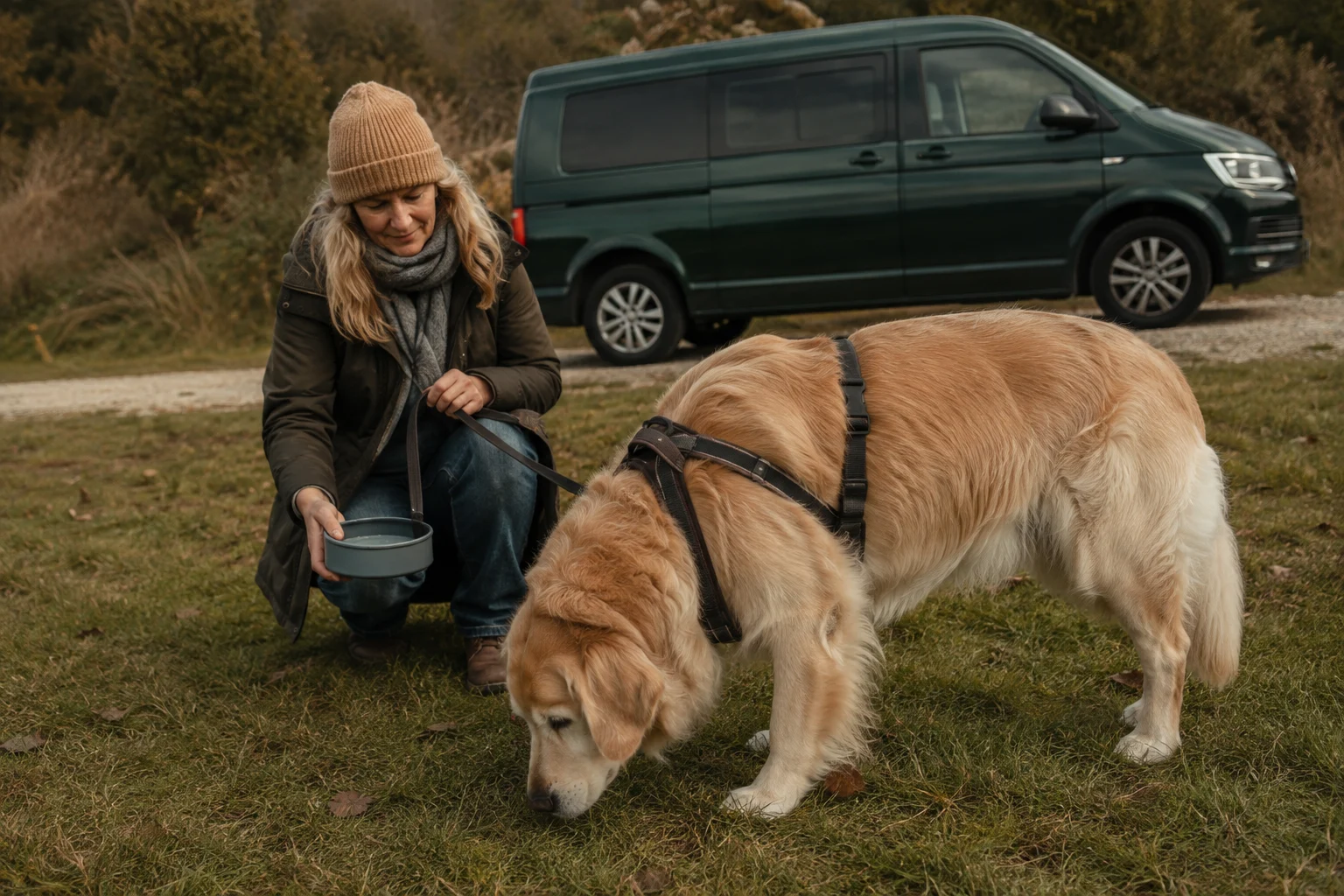
For non-commercial moves with your own dogs and cats within the EU, without a sale or transfer of ownership. Entry from Russia, Serbia and other non-EU countries needs a separate review. This checklist does not cover other animal species.
Start with every country on the route
A move between two EU addresses may include a non-EU leg. List the countries on the actual route, not just departure and destination. If navigation suggests another road, check the implications for pet travel before changing the plan.
Record where the animals stay overnight, who accompanies them and when you get the keys. A vet needs the itinerary to check documents; a transport provider needs it to plan space. Being able to travel yourself does not establish that your dog, cat and carriers are accepted by the chosen transport.
Identify the document you already have
A vaccination booklet and a European pet passport are not necessarily interchangeable. Your Europe describes the EU passport issued by an authorised vet to an EU-resident owner. Check the document type, animal and owner details, and current entries.
If you recently entered from a non-EU country on an animal health certificate, do not assume it became invalid at the border. The European Commission allows onward EU travel within its validity period. Show the specialist the complete document and original entry date. The cover alone cannot establish whether it covers the next leg.
Check the rule: Your Europe: pet passports and travel documents · European Commission: travelling with a pet within the EU
Check identification and vaccination continuity
The basic checks include identification and a valid rabies vaccination. Under EU rules, vaccination must not predate chip implantation or reading; at least 21 days must follow completion of the primary protocol. Timely boosters depend on continuity with the previous valid vaccination.
Ask the vet to scan the chip and compare its number with the passport. Check the vaccination’s start and expiry dates separately. If an entry has expired or is unclear, establish the eligible travel date first. Do not automatically apply a non-EU entry antibody-testing calendar to an ordinary move within the EU.
Check the rule: European Commission: travelling with a pet within the EU
Clarify accompaniment and animal numbers
Regulation 2026/131 covers non-commercial movement. When an authorised person accompanies the pet, the owner must travel within five days before or after, with written confirmation. The ordinary limit is five animals in one vehicle. Event-related exceptions have separate conditions.
Give the organiser the real dates and complete party, including other passengers’ animals. If a dog is collected a month after you move, or is being transferred to a new owner, calling it a “personal trip” does not make the same document checklist applicable.
Check the rule: EUR-Lex: Regulation (EU) 2026/131 · European Commission: travelling with a pet within the EU
Check the destination’s conditions
For example, a dog arriving in Finland generally needs veterinary Echinococcus treatment 1–5 days before entry, recorded in its passport. The Finnish authority explains exceptions and a regular programme for repeated trips separately. Do not apply these conditions to a cat or every EU destination.
Young animals face national differences. Before booking, find destination and transit requirements for your pet’s age and breed. Share them with your vet; choose preparation and medication with the professional, rather than from someone else’s travel report.
Check the rule: Finnish Food Authority: non-commercial movement from EU countries · European Commission: travelling with a pet within the EU
An illustrative route: Prague, Munich, Lyon
Suppose two adults are moving with a dog, a cat and six boxes. The animals have valid EU passports and vaccinations; the family is considering an overnight stop in Munich. This is a hypothetical planning exercise, not a MIRNO departure or customer case.
Even with documents ready, four arrangements remain. Record them in a table, with the provider’s name and written answer alongside each item. If the boxes are replaced by furniture, the estimate and vehicle space need another review.
| Part of the plan | What to check |
|---|---|
| Leaving Prague | Vehicle space accommodates two people, two animals, carriers and six boxes. |
| Overnight in Munich | The hotel confirms the dog and cat of the relevant size, charges and check-in time in writing. |
| Arriving in Lyon | Keys are available, the vehicle can stop and someone can receive the belongings. |
| A delay on one leg | There is a contact, a communication plan and a way to agree extra overnight costs. |
Agree transport and daily needs separately from documents
A driver or airline needs carrier dimensions, weights and animal numbers. Accommodation needs the pets’ species, size and number, plus arrival time. Give each provider the details that affect their part of the move.
After moving in, check local animal registration, owner contact information and dog-walking requirements. Keep the vaccination history and old clinic’s contact for your new vet. Accessible food, water and a place to rest should arrive with the pet, even when most belongings are delivered later.
Close the remaining questions before departure
Update the list after the last change to dates, passengers or route. Replace “documents ready” with who checked them and for which journey. Replace “pet-friendly hotel” with the answer about your booking. If there is a delay, you will know which arrangements need reconfirmation.
- Every country and the applicable movement category have been checked.
- The document covers the next leg; chip and vaccination entries match.
- Accompaniment and animal numbers are agreed.
- Destination and transit conditions have been checked for the actual pets.
- Transport, overnight accommodation and arrival arrangements are confirmed.
- Original documents and delay contacts remain accessible.
Sources and further reading
- European Commission: travelling with a pet within the EU
- Your Europe: pet passports and travel documents
- EUR-Lex: Regulation (EU) 2026/131
- Finnish Food Authority: non-commercial movement from EU countries
Before booking, recheck conditions for your countries, dates and operators.
Put this into your plan
- Travel checklist
Tick completed preparation steps and print the list before your journey. - Coordinate people, pets and belongings
The information needed to review your entire move to the new address. - If you are entering the EU
A separate preparation guide for non-EU departures, including a worked calendar.